
Before We Were Numbers: A Personal Essay on Indigenous Memory and Resilience
Content note: reflections on intergenerational grief, addiction, and colonial violence.
Aaniin indinawemaaganidog, hello all my relations. As National Indigenous History Month begins, I want to honour my beloved nokomis, Ngo-Waabigwan (Karen Chaboyer). My grandmother is a residential school survivor and educator who is dedicated to sharing her story on the agonizing abuse she endured throughout much of her life. She is a strong, loving, and resilient woman who I deeply look up to. In 2020, my grandmother published her memoir, a story of perseverance and heartache that took many decades to bring to the surface. In this, she reflects on life before residential school, the abuse in the institution, and how she navigated life among the trauma with no Indigenous identity to grasp onto. With each heartbreaking sentence, I found myself continuing to turn the page to see how she would overcome every painful barrier placed before her. Ngo-Waabigwan uses vivid imagery and emotional recollection to immerse readers within the realities of residential school trauma, making it impossible to emotionally distance oneself from the violence Indigenous children endured. Reading her story felt like walking on broken glass. Tears were shed upon the first reading of the book, and I was a wreck reading it once more after giving birth to my daughter, Clementine Dulce. Being a mother while reflecting on the intergenerational trauma inflicted upon us through colonialism has shown me that resisting the patriarchal standards imposed by western institutions is, in itself, an act of maternal love.
As Indigenous people, many of us carry heartache with each life created, almost as though we are born into grief before we even understand it. The memoir illustrates how the violence of residential schools extends far beyond one generation, shaping the emotional realities of Indigenous families long after the institutions themselves closed. Many of us grow up wondering how our lives will end. Whether we will overdose, go missing, or be murdered by those who can go without punishment. Even then, most of our bodies will never be buried in the soil we nourished for hundreds of thousands of years. Instead we are in the depths of freshwater, where nothing is present but sturgeon and walleye—with not a sight of blunt force trauma or DNA. And the case closes before you have reached all stages of grief. It is painful watching our people leave this Earth in devastating ways, and I acknowledge the privilege I carry in being able to escape the restraints of one of the many deteriorating paths—alcoholism and substance abuse. My grandmother defeated the evil spirits that cling onto our people like tar, which is why her strength has always inspired me to become a better version of myself. She allowed herself to confront the pain despite being afraid of it, by letting go of something she had known her whole life that was meant to exterminate her as a child (or, at least, take her life later in adulthood). With this, my grandmother is certainly the strongest woman to walk this cruel world. Ngo-Waabigwan was once reduced to the number 33. Today, Indigenous peoples are no longer assigned numbers in the same way, yet we continue to be reduced to statistics tied to violence, incarceration, poverty, addiction, and death.
These statistics are not distant realities to Indigenous families—they live within our homes, our memories, and our bloodlines. Two of my grandparents are residential school survivors. My maternal grandfather was a victim of the colonial violence inflicted upon them by the deemed innocent nuns and priests of the Catholic Church. His name was Melvin, but the spirits know him as Begamaanaakwad. I am uncertain of the exact translation of his Spirit name, however I can identify one word—Aanaakwad, cloud. He received his name during the final days of his life, but it had always been a part of his being. I recall him feeling a sense of wholeness upon being given the final piece of his identity as an Indigenous person. For the first time, my grandfather seemed at peace, as though he had finally found his way home and our ancestors would be able to recognize him. This moment reflects the importance of Spirit names within Indigenous identity and healing. Receiving his name allowed my grandfather to reconnect with what colonial institutions attempted to erase from him.
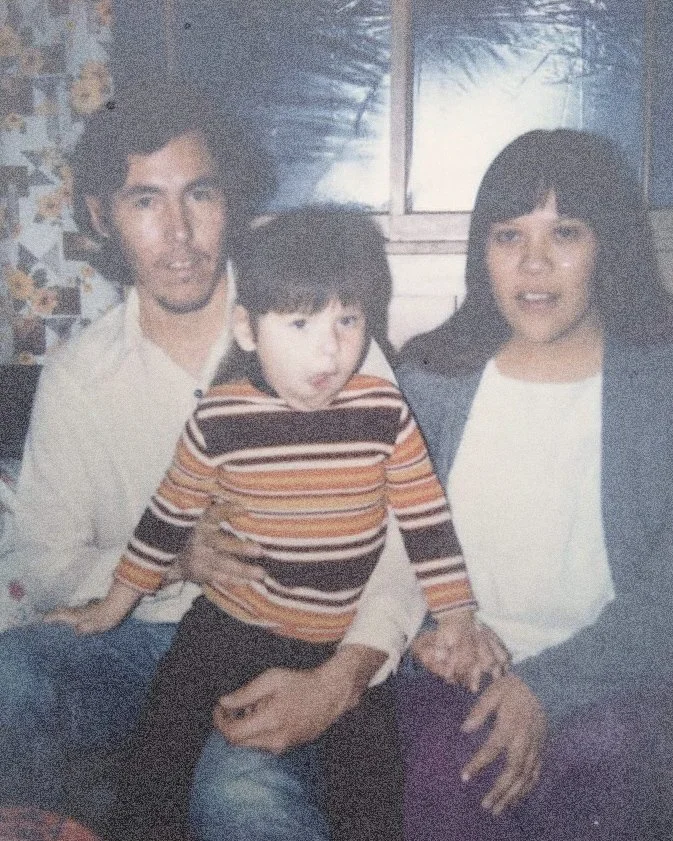
Begamaanaakwad and Irene, my maternal grandmother.
I remember Begamaanaakwad as a quiet old man who drove his truck with his grandchildren in the back, who ate peanuts on a recliner while watching Jeopardy! with me. The crackling sound of opening the shells of peanuts and walnuts is a niche memory of life on the reserve, back when I would spend summers with my maternal grandparents. However, I was never able to connect with him in the same way I am able to connect with my paternal grandmother. I only knew him through fragments of childhood memories. Yet I yearn for those days now, especially knowing how much was taken from him before I ever had the chance to truly know him. But then again, I don’t think I would have wanted to understand him more fully—my family later unveiled many stories that a child would have been unable to grasp. The grim realities of unhealed trauma are something I fear, yet it feels ignorant to push them away out of my own discomfort. I carry these memories with a hole in my chest, knowing that I will never truly know this kind of pain on a more profound level. In many ways, I have come to understand that identity is carried not only through memory, but through the sacred teachings we continue to pass down. By continuing the tradition of receiving Spirit names, I was able to receive mine alongside my daughter, who was four months old at the time. Clementine is known as Ozhaawashko-Ma’iingan and my name is Nagamo-Ma’iingan. This is who I truly am beneath flesh and bone. My paternal grandfather is named Giiwedinaabow, his mother is Giizhibaagaabawik.
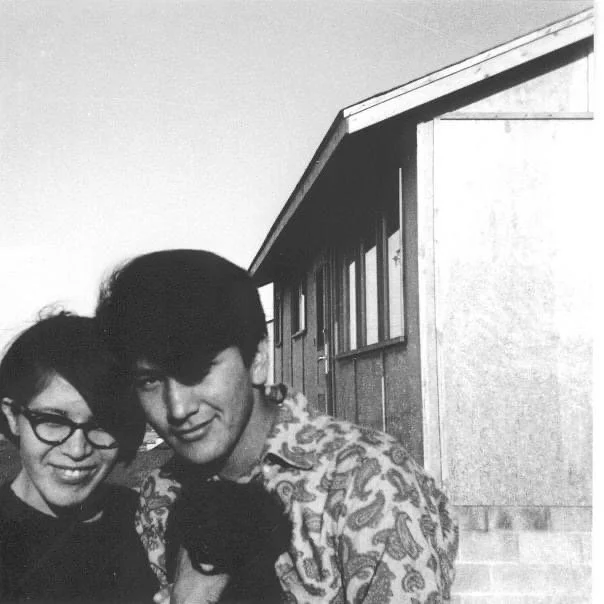
Ngo-Waabigwan and Giiwedinaabow.
Long before she became 33, Ngo-Waabigwan was simply a little girl growing up alongside her family in Rice Bay. Before being sent to residential school, my grandmother explained her ways of living as secluded and peaceful. Although her family was packed like a can of sardines in a small cabin located in Rice Bay, her early life remained peaceful and deeply connected to the land. Her mother, Bella, was a very hardworking and agile woman who was always cooking rabbit stew, bannock, and all sorts of pie for her children. Her father and brothers hunted for their food to feast upon, and to me that is a luxury that many urban Indigenous people are unable to experience. This quiet life sounds beautiful beyond comparison, yet so elusive with the presence of colonial violence lurking in the forest like a coyote.
Yet hidden beneath this peaceful life was the growing shadow of colonial violence. Ngo-Waabigwan went to St. Margarets Residential School on Fort Frances/Couchiching First Nation, when she was just a small child at only six years old. In her book, she recalls being eager to finally be in school with her older brothers and sisters. However, her fear grew as her mother brought her closer to the cold and eerie building that held years of emotional, physical, and sexual abuse. She did not want to be left behind and begged her mother to take her home. Reading this part of the story is gut wrenching. Today’s children cry when their mothers leave them at daycare, therefore knowing my grandmother cried for hers in residential school is an entirely different kind of pain because her mother left her there knowing the violence that could occur behind those closed doors.
Ngo-Waabigwan’s parents were fluent in Anishinabemowin, though did not teach their children the language in order to keep them alive because by speaking their language meant immediate punishment and oftentimes death. The memoir emphasizes the devastating impact residential schools had on Indigenous language transmission, forcing many parents to withhold their language from their children as a means of survival. This act of cultural genocide impacted us for generations, with many of us still trying to reclaim and learn our language. For children like Ngo-Waabigwan, cultural genocide began through the stripping away of identity, language, and dignity.
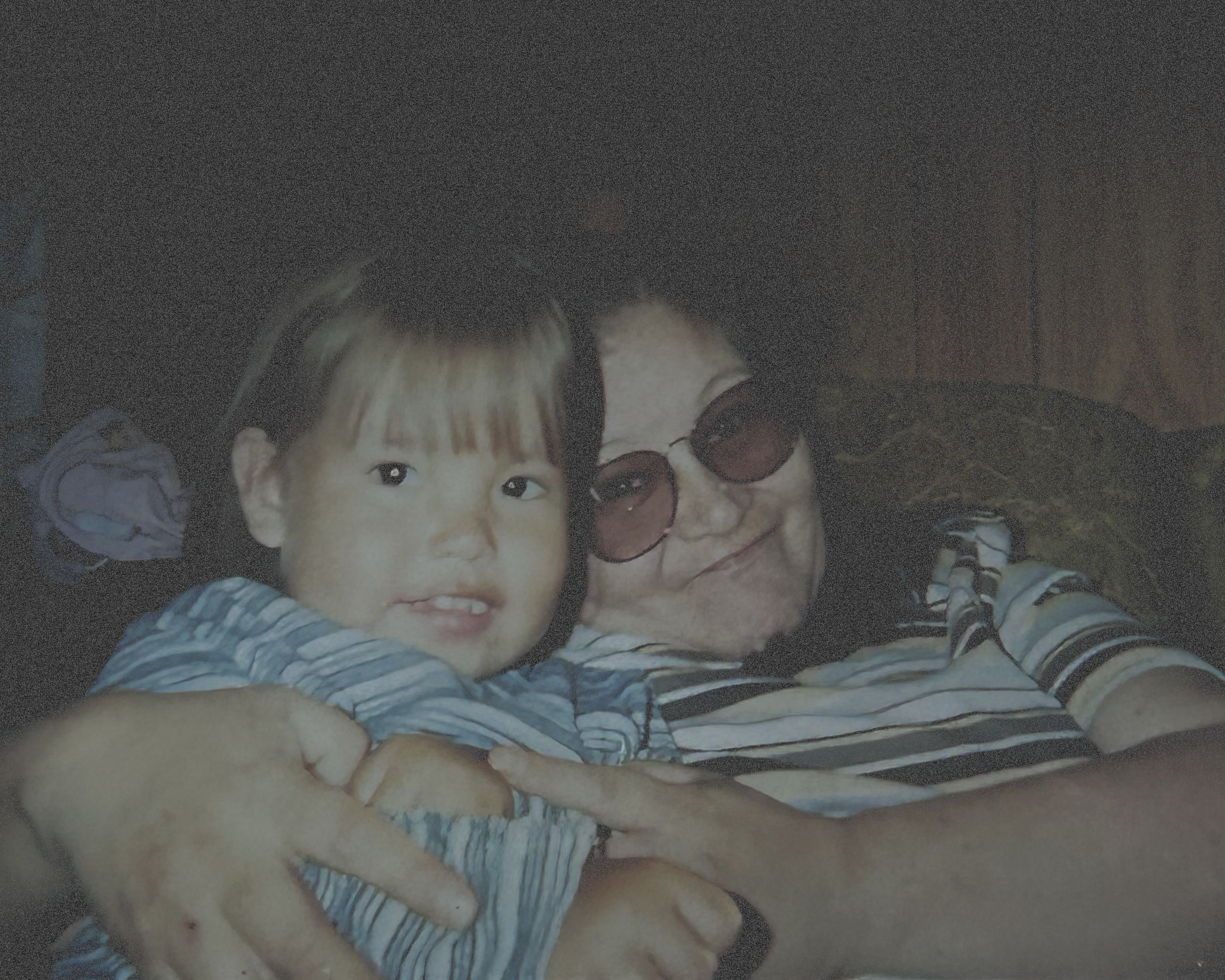
Nagamo-Ma’iingan and Ngo-Waabigwan.
My grandmother arrived at residential school freshly bathed, her hair tied into neat pigtails and dressed in new clothes she had been excited to wear for her first day of school. Like many young children, she entered the building with innocence and curiosity, unaware of the violence waiting behind its doors. Upon arriving, everything was stripped away by the nuns, who told her she was still “a dirty little Indian.” The clothes she had been proud to wear were taken from her body, her hair was cut, and the identity she carried as an Anishinaabe child was immediately treated as something shameful and unworthy of existence. What should have been a moment of childhood innocence quickly became the beginning of cultural erasure, humiliation, and loss. In only a matter of moments, the institution severed her from the familiarity of home, family, language, and comfort. Her identity, spiritual wellbeing, and childlike wonder were gone in an instant. Ngo-Waabigwan was no more—she was now 33.
Miigwech for taking the time to read my post for National Indigenous History Month. If you are interested in supporting my beloved nokomis, Ngo-Waabigwan, her memoir They Call Me 33: Reclaiming Ingo-Waabigwan can be found here: